Showing posts with label blue shark. Show all posts

Friday, 21 October 2016

CSHAS 2016: Megafauna madness over the Celtic Deep

Day 15: Friday 21st October

Skipping ahead a bit here since the last blog update but doing so in order to share some notes and pics from an absolutely superb day spent watching an impressive abundance of 'marine megafauna' over the Celtic Deep, well to the south of Co. Wexford.

As the first rays of dawn broke, a peek out the cabin porthole revealed a flat calm sea and visibility clear to the horizon line. After a quick breakfast we were on deck and ready for action. Within minutes the seabird team picked up a small group of harbour porpoise off our port side which when radioed in to the marine mammal team was met with a reply of "we're watching more off to our starboard!". After trying (and failing) to spot some porpoises during the inshore legs of our transect lines off Cork, Waterford and Wexford over the past two weeks, we were surprised to finally encounter them this far offshore and what's more, we weren't expecting to see so many! Every time we scanned we seemed to find more and more porpoises and at one stage a single scan across the view-shed revealed no less than 58 animals! Final tallies for the day almost reached 200 animals!

Consulting with the Marine Institute fisheries scientists in the lab who were monitoring the underwater acoustic images being recorded by the ship, it was clear that there was a lot of activity going on below us with masses of plankton, krill, forage fish (herring) and even a plethora of bluefin tuna showing up! This abundance below water was certainly mirrored at the surface and in addition to the harbour porpoises we noted lots of common dolphins, racked up no less than fifteen sightings of Minke whales, two fin whales (one of which crossed right in front of the bow at close range), a single humpback whale, an Atlantic grey seal, several breaching bluefin tuna and even some blue sharks swimming at the surface (being able to see the latter is a testament to how calm the conditions were).

No doubt there was some duplication in sightings at play due to the close proximity of the parallel survey transect lines, yet the marine mammal observers in the crow's nest still amassed an impressive total of 78 sightings involving up to 500 animals!

After a ten hour day out on deck we are all a little tired and more red in the face than usual so I'll finish up and let the following selection of pics tell the rest of the story...


Ideal conditions over the Celtic Deep (c) Niall T. Keogh

Harbour porpoise (c) Niall T. Keogh

Blue shark 'knifing' at the surface (c) Niall T. Keogh

Blue shark clearly visible underwater! (c) Stephanie Levesque

Bluefin tuna (c) Niall T. Keogh

This common dolphin showed exceptionally well, actively surfacing just metres away from the ship. Closer examination of the pics suggest it may be unwell. The protruding rib-cage and sunken appearance behind the skull (known as a 'post-nuchal depression') indicate that it is in poor body condition (c) Niall T. Keogh

A couple of perfectly healthy looking common dolphins (c) Meadhbh Quinn

Minke whale showing the typical, falcate (sickle shaped) dorsal fin (c) Gary Kett

Minke whale showing a straighter, more erect shape to the dorsal fin (c) Meadhbh Quinn

This humpback whale spent quite some time logging (resting) at the surface (c) Meadhbh Quinn

But after a while the humpback eventually treated us to a nice tail-fluke! (c) Meadhbh Quinn


Fin whale surfacing sequence (c) Meadhbh Quinn / Niall T. Keogh

Irish Whale and Dolphin Group marine mammal observers: Meadhbh Quinn and Gary Kett

Marine and Freshwater Research Centre GMIT seabird observers: Stephanie Levesque and Niall Keogh

Celtic Sea sunset (c) Gary Kett

Saturday, 30 July 2016

WESPAS Days 20 to 25: southern Celtic Sea to northern Bay of Biscay

Day 20 to 25 sightings: 23rd to 29th July 2016

After somewhat of a lull in cetacean activity in the mid Celtic Sea region, things started hotting up (literally!) as we approached the southern reaches of the Irish offshore territory and into UK and French waters. The sea surface temperature peaked at around 18°C and the ocean sunfish were out in force, as were common dolphins, with several groups seen every day ensuring the marine mammal observers were kept busy. We also recorded several breaching tuna, which looked to be bluefin and albacore. Our hoped for leatherback turtles didn't materialise however.

The outermost survey transect lines brought us close to or just over the continental shelf edge, an area of high productivity where several fin whales and even a single striped dolphin were noted. While surveying near the shelf edge along the northern end of the Bay of Biscay one evening, we spotted two very tall blows out towards the horizon line on our starboard side, presumably from fin whales. Soon after, another group of three fin whales crossed the path of the ship ahead of us from port to starboard, offering fantastic views.

Hard to beat good looks at the second largest animal on earth! 

Fin whale (c) William Hunt

 Fin whale (c) William Hunt

Fin whale (c) William Hunt

Fin whale (c) John Power
(you can just about make out the white colour to the right-hand side of the lower jaw in this pic, a diagnostic ID feature for the species)

We had some really nice sightings of bottlenose dolphins too, both near the shelf edge and also over the shallower shelf waters. Each group seemed to give the ship a wide berth, travelling past at distance. We tried to take as many pics as possible to see if we can match them to any known group (bottlenose dolphins with distinctive notches, scars and colourations on their dorsal fins are catalogued across Europe). It would be great to find out which group these animals belong, 'offshore' or 'coastal'?

Bottlenose dolphins (c) William Hunt

Common dolphin (c) William Hunt

Common dolphins (c) Mick Marrinan

Ocean sunfish (c) William Hunt

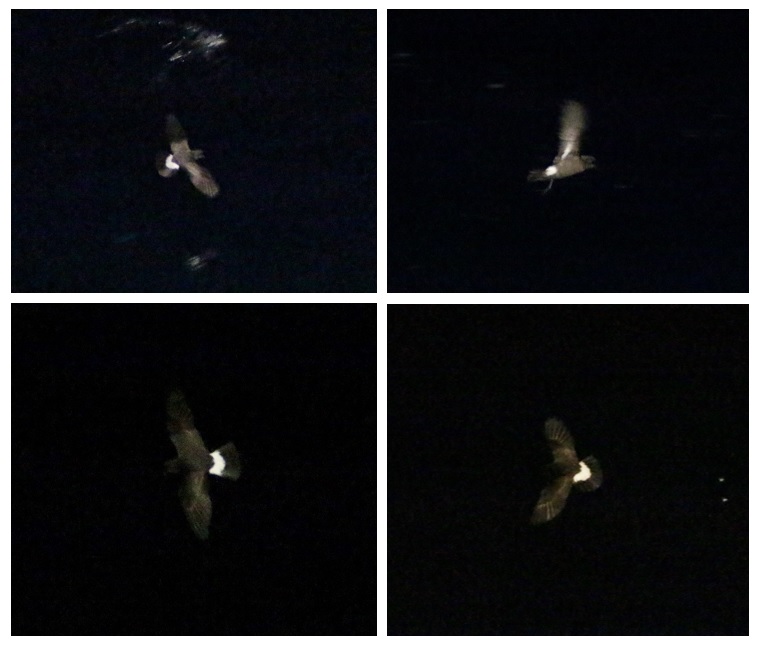
Sightings of cool marine wildlife have not just been limited to daylight hours. While on transect lines, the ship stops on station at night from midnight to 4am as part of the method for surveying boarfish. During this time a whole manner of life is attracted to the waters around the ship, illuminated by the lights. Fish such as saury start appearing in their droves to feed on gathering plankton which in turn attract predatory species like garfish, blue sharks, common dolphins and even seabirds such as fulmars and European storm-petrels (plus a grey phalarope one night circling the ship, calling!). 


This nocturnal wildlife spectacle has provided the night shift scientists and crew with endless entertainment (the blue sharks stealing the show, hands down). Even some of us day shift observers had to stay up way past our bed time in order to witness it!


Blue sharks (c) John Power

Blue shark (c) John Power

European storm-petrel circling RV Celtic Explorer at 2am (c) Niall T. Keogh

The seabird list finished up on a total of 26 species with the latest additions being Barolo shearwater, grey phalarope and yellow-legged gull. 

Barolo shearwater (which breeds on Atlantic islands such as the Canaries) was a real highlight as it is a rarely observed species around Irish and UK waters but more often seen in the Bay of Biscay, so the bird we saw travelling north with a Manx shearwater just inside the UK offshore territory some 270km southwest of Scilly was perhaps just about on the edge of its perceived regular range, although it seems we have a lot more to learn about their occurrence closer to home as this tracking study has shown.

A flock of 17 grey phalaropes was flushed ahead of the ship on the evening with lots of fin whale activity near the shelf edge along the north side of the Bay of Biscay. These pelagic waders (which feed on zooplankton) will already be on their way south to wintering grounds off the west coast of Africa. On examining pics of the flock, it appeared that quite a few females were present. Grey phalaropes breed in the High Arctic, where the males incubate the eggs and safeguard the chicks during the breeding season while the females leave soon after the eggs have been laid so it is not surprising that we have seen a flock of mostly females this far south already. Their work is done!

A quick check of the gull flock following the ship while west of Brittany yesterday afternoon produced a single fresh juvenile yellow-legged gull, as expected, but enjoyed immensely by the gull enthusiasts on board (...enthusiast, to be precise!).

Otherwise, the past week for the seabird team has been spent soaking up excellent views of yet more Cory's shearwaters and great shearwaters, a very good showing of European storm-petrels and some long-tailed skuas. A few more Wilson's storm-petrels were also seen, bringing the tally for the trip up to 13 individuals. 

Cory's (left) and great (right) shearwaters (c) William Hunt

Cory's shearwater (c) William Hunt

Great shearwater (c) William Hunt

Juvenile lesser black-backed gull (c) Niall T. Keogh

 Gannet (c) William Hunt

Gannets (c) William Hunt

After 25 days at sea, the Western European Shelf Pelagic Acoustic Survey (WESPAS) has come to an end. We are docking in Falmouth in Cornwall this morning from where we will make our way home to Ireland, giving us plenty of time to reflect on the fantastic marine species which we have had the privilege of seeing over the past few weeks. From here the RV Celtic Explorer will make its way to Germany to  undertake another survey.

We'll finish up with a pic of the final species list for the survey and a heartfelt thanks to Chief Scientists Ciaran O'Donnell and Graham Johnston (Marine Institute) for their continued support of offshore marine mammal and seabird surveys and to the officers and crew of RV Celtic Explorer for all their valued assistance throughout the cruise. Until next time...