Saturday, 20 September 2014

Cetaceans on the Frontier 6: An Undergraduates View

Five lucky 4th Year students studying in the Galway-Mayo Institute of Technology were given the opportunity to go on a voyage with the Cetaceans on the Frontier scientific crew and we happen to be those lucky five! We will provide you with a brief description of our daily routine and exciting escapades.

Day 1: After attending a safety briefing, a quick intro with the crew and a look at our luxury pads, we departed from Galway Bay at 11 o’clock Wednesday morning to the promise of a beautiful sunny day. We headed west for the M6 weather buoy 200 miles from the Irish coast, which needed a quick replace of wind sensors.

Some people will do anything for tickets! (c) Mick Marrinan

On this particular survey we were tasked with three main roles; the first of these was as tracking observers. This entailed climbing to a platform 17m above the deck (the crow's nest) and keeping a keen eye out for any cetaceans. The second task was to man logger, a piece of software that helps to compile the sightings into a database along with GPS positioning. And finally, thermal imaging (predator vision), to try and spot the heat of the blows from the larger cetaceans.

Although the weather was almost perfect, there were very few sightings to mention. The first sighting was of some bottlenose dolphins followed by the aptly called common dolphins bow riding at the front of the vessel and later in the evening a minke whale put in an appearance. Good times!

Common Dolphin (c) Mick Marrinan

Day 2: If day one, weather wise, was near perfect conditions for carrying out a cetacean survey, despite the wind and rain, day 2 managed to have some fantastic sightings. With the frequent visits of common dolphins to begin the day it quickly lead to greater (bigger) things! Beginning with a visit from 5 white-sided dolphins, our next encounter was with one of the oceans giants, the sperm whale which was also recorded on a towed hydrophone. We also had the pleasure of seeing striped dolphins which are rarely sighted in Irish waters, next we stumbled upon the second largest animal in the world, the fin whale. In total we saw four individual fin whales. Amongst these sightings we had the privilege of watching a pair swimming in sync and possibly feeding. To round off the day we were entertained by an army of common dolphins which was at least 50 strong.

Fin Whales (c) Mick Marrinan

This being our first voyage, to see so many different species in the one day was truly awesome! Lets hope for more of the same tomorrow.

Common Dolphin (c) Mick Marrinan

Day 3: Today provided us with a killer opportunity we never expected!!  We began the day with a visit from a few fin whales, one of which was keen to stay nearby for around 45 minutes, a real treat.  Frequent visits from common dolphins, including some lively calves, kept us on our toes until we came in counter with one of the most intelligent and social able creatures in the sea! Shortly after lunch, a pod of seven killer whales gracefully swam past our view. It included two adult females, four calves and a burley adult male. We managed to get some awesome pictures and a memory we will never forget!!

Undergrads out!!! ;)

The GMIT crew! (left-right) Dr. Joanne O'Brien, Pilar Byrne, Erika Brown, Ryan McGeedy, Dr. Simon Berrow, Mick Marrinan and Derek O'Driscoll

Friday, 19 September 2014

COTF6 Day 3: A Killer Spree!

We found ourselves over the South West Porcupine SAC at 8am this morning in order to retrieve Static Acoustic Monitoring (SAM) devices which were moored back in May (supported by Woodside) in order to gather acoustic detections of cetaceans present there throughout the summer months. After the SAM devices were safely on board we steamed North East across the top of the Porcupine Seabight to the second SAM site of the day, conducting continuous visual surveys in between.

Crew of the R.V. Celtic Explorer retrieving the SAM equipment (c) Róisín Pinfield

Frequent sightings of fin whale blows were present from the off, with at least three individuals confirmed in relatively quick succession. After that, baleen whale activity ceased for the day but the cetacean observation team was kept busy with frequent sightings of common dolphins with groups of up to 60 animals including calves coming in to inspect the vessel. Another two ocean sunfish were also logged today, drifting by at close range.

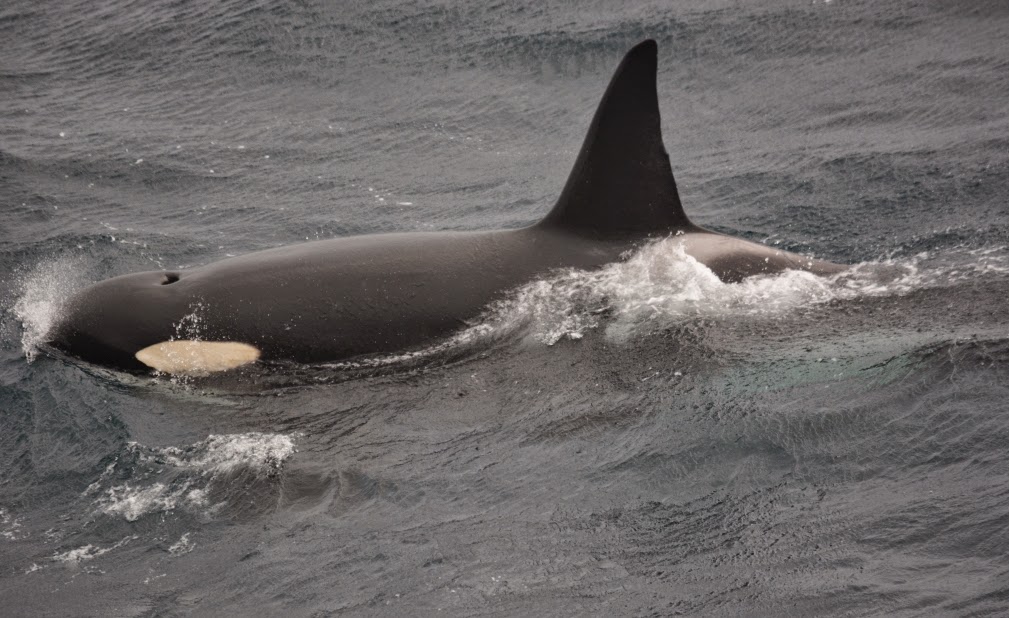
And so the day continued, with sightings tipping away at a fine pace. Nobody would have predicted the events that would unfold after lunch however when at 13:30 the call came over the walkie-talkies from Rossa and Róisín of “KILLER WHALES!!!”. Two enormous, black, triangular dorsal fins came looming out of the water together on our starboard side no more than 50m out! Needless to say our full attention was now focused on them! The ship was manoeuvred in order to attain photo-ID pics (which now became our top priority) but the whales did us a massive favour and made several passes alongside us at close range allowing for excellent views of the eye masks, dorsal fins and on some occasions, tail fluking! As the minutes ticked by at incredible speed our count increased from two to three to five to seven. A mix of large fins and medium to small fins were noted, indicating a family group. After 20 minutes or so of fantastic viewing with photo-ID images secured, the group of killer whales split off on their own track and we left them to it continuing back on our survey route.


Killer whale (c) William Hunt

Killer whale (c) Joanne O'Brien

Killer whale tail fluking (c) Joanne O'Brien

Killer whale tail fluking (c) Joanne O'Brien

A superb encounter with one of the world’s most instantly recognisable and much loved cetaceans aside, the sighting of today’s killer whales was an important find for the Cetaceans on the Frontier survey. These offshore animals are infrequently seen so another ‘dot-on-the-map’ has been added to the distribution database which will build on a slowly increasing understanding of their pattern of occurrence and ecology. The photo-ID images secured today are quite simply priceless and will be catalogued and compared to an international database of killer whale images, hopefully coming up with a match or providing some baseline data to work with should future sightings be made.

Killer whales in Irish waters seem to have a real element of unpredictability about them. Some of the Marine Mammal Observers present today have many hundreds of observation hours and thousands of at-seas miles under their belt without having encountered killer whales before today, whist for some of the students joining us on the trip for their first time offshore, things could not have worked out better! Whether informed planning or blind luck had anything to do with it still does not detract from how absolutely amazing the 20 minutes we had with these animals this afternoon was. Smiles all round!

Killer whales with a Great Shearwater and a Fulmar in attendance (c) William Hunt

The seabird team had a busier day all round compared to yesterday with a mixed species flock off the stern throughout. The avian highlight was undoubtedly the continuous presence of trailing great shearwaters, frequently coming along our port side showing down to 50m at times! Birds seemed to be joining and leaving this group every few hours or so, making a final tally hard to conjure up but the single highest count we had was of 31 birds in one flock. Several sooty shearwaters were mixed in with the greats, the single highest count of those being four, otherwise the associating flock was made up of your usual gannets, fulmars and lesser black-backed gulls. Amid the commotion of killer whale activity, a nice mixed species group of seabirds followed their every move, with great skuas and gannets tracking from the air. Great shearwaters and European storm-petrels skirted over the killer whales on surfacing and with them the second Wilson’s storm-petrel of the trip. A serious combo of rare marine fauna in one field of view! The remaining species of note observed today included a single adult Sabine’s gull, a dark morph pomarine skua, a juvenile kittiwake, four great skuas, 11 Manx shearwaters and 40+ European storm-petrels.

Great Shearwater (c) Róisín Pinfield

Great Shearwater flock (c) Jason McGuirk

This evening we arrived at the Hovland Mound SAC where the crew of the R.V Celtic Explorer retrieved the second lot of SAM devices of the day. Tonight we head South East towards the Belgica Mound SAC for the third and final batch of SAM devices after which we will zig-zag our way along the Eastern edge of the Porcupine Seabight, hoping for something big and blue.

And we better not let tonight’s blog post go by without highlighting the steadfast dedication of Donegal supporters on board the R.V. Celtic Explorer

The Donegal flag proudly flown from the M6 weather buoy by the R.V. Celtic Explorer's own Brian Sharkey (c) Damien McCallig

Thursday, 18 September 2014

COTF6 Day 2: Porcupine Bank Bonanza!

What a day! We awoke this morning with news from Enda and John (at the tail end of their hydrophone/acoustic monitoring night shift) that common dolphins were present around the R.V. Celtic Explorer throughout the night from about 02:30. The daytime observation teams were out on deck and in position, ready to go from 07:30 but were faced with a misty horizon, moderate sea state and some patches of rain for much of the day. Not ideal but we’ve been out in worse!

Steaming due West for the M6 weather buoy over the top end of the Porcupine Bank, crossing over a depth of 2,000m we came across a group of five Atlantic white-sided dolphins, a species limited to the deeper offshore waters within the Irish territory. In typical fashion for these dolphins, they didn’t approach the boat too close and headed off fairly quickly as we made our way along the transect line. Hopefully we’ll bump into more white-sides again over the coming days and secure some nice images as they are a species infrequently seen or photographed in Irish waters, at least in recent years.

About half an hour away from the M6 buoy, a whale blow appeared dead ahead up to 800m away. The frequent nature of the short, bushy blows coming from the same spot lead us to believe a sperm whale was the culprit and a view of the body during a break in the swell confirmed this. While concentrating on the sperm whale we were coming up on, a group of energetic and acrobatic, small sized dolphins suddenly started moving through our field of view with tremendous speed. Leaping clear out of the water like sleek, silver bullets it was instantly apparent that these were not your run of the mill common dolphins. A sub group breached not more than 100m from the bow and a solid view of the flanks complete with a thin, black, wavy line, confirmed that these were, as suspected, striped dolphins! In all three groups of 10-15 animals each barrelled North in front of us, clearing the water in an impressive, organised phalanx before re-entering with a forceful smack of the tail, sending a sizeable splash of water into the air. Striped dolphins are a real sub-tropical, oceanic species with sightings in Irish waters a relatively recent phenomenon, typically confined to late summer and autumn when surface water temperatures are at their highest. As such the window of opportunity for seeing them appears to be quite short and not surprisingly, these animals constituted a new species or only a second/third sighting for many present on deck at the time. Truly exciting stuff!

Striped Dolphins (c) Jason McGuirk

Striped Dolphins (c) Simon Berrow

Striped Dolphins (c) Hannah Keogh

Once maintenance works on the M6 buoy were completed in ever efficient fashion by the ship’s crew, we changed track and headed South East along the shelf edge, crossing over a changing water depth as we went over the slope, from 3,000m to 500m. Soon after a shout of ‘blow!’ went out and the on deck cetacean observation teams were treated to some nice, prolonged views of a feeding fin whale, the second largest animal on Earth. We came upon more fin whales later in the afternoon, this time a group of three animals actively feeding in close proximity with plenty of blows, side rolling and some shallow lunge feeding on offer at close range! Absolutely fantastic!

Fin Whale (c) Simon Berrow

Fin Whales (c) Simon Berrow

Fin Whale (c) Joanne O'Brien

Fin Whales (c) Hannah Keogh

Fin Whale lunge feeding/side rolling (c) Simon Berrow

Fin Whale lunge feeding/side rolling (c) Joanne O'Brien

The evening then drew to a close for the cetacean team with multiple sightings of common dolphins (some groups size of 40 animals) coming in to bow ride as we came over a water depth of 500m. The nocturnal acoustic team took over at 20:00 and soon after several detections of sperm whales were made really close to the ship, their position calculated as near as 200m! We were all able to gather in the dry lab and listen to their rhythmic clicks through the speakers, sounding almost like an electric fence pulse. Also best not forget to mention the sightings of two different ocean sunfish which we passed by at close range during the day! Bizarre fish altogether and always great to see.

Common Dolphin (c) William Hunt

Ocean Sunfish (c) Hannah Keogh


Sperm Whale clicks (c) Enda McKeogh

The seabird team had a day of quality over quantity, with just a trickle of fulmars, a handful of gannets and a small entourage of lesser black-backed gulls in attendance. Saying that a couple of excellent sightings early on made all the effort worthwhile (cetaceans aside!). A great shearwater came in for a look at us first thing before carrying on its way to the South. Not long after we approached a group of fulmars on the water with a Wilson’s storm-petrel bouncing around them which showed well at close range before travelling on to the West. Both of these species have undertaken a mammoth journey from their breeding grounds on sub-Antarctic islands to Irish waters in order to avail of rich feeding here in the late summer and autumn. Amazing to think the distance they have covered. Intrepid birds! A pomarine skua spotted by Simon, trundling by the ship late evening was the last addition to the seabird list for the day.

Great Shearwater (c) Niall Keogh

Wilson's Storm-petrel (c) Niall Keogh

Wilson's Storm-petrel (c) Niall Keogh

Wilson's Storm-petrel (c) Niall Keogh

The murky visibility, rain and moderate North East wind dropped some more migrating passerines (songbirds) onto the ship overnight with 10+ meadow pipits, 3 wheatears and a white wagtail doing the rounds of each deck throughout the day, some even ending up inside the dry lab! The inclement weather must have disorientated them whilst on migration to Iberia/West Africa and the R.V. Celtic Explorer looked like a good place to rest. A few individuals became very tame as they searched around the ship for scraps of food, but ignored all of the tasty morsels we left out for them! Hopefully clearer conditions in the morning will allow them to get their bearings and head off again on their merry way.


Wheatear (c) Jason McGuirk

White Wagtail (c) Niall Keogh

Meadow Pipit (c) Niall Keogh


Now we make our towards the Porcupine Bank SAC where we will retrieve a static acoustic monitoring device positioned there in May and will continue East across the Porcupine Seabight.

Wednesday, 17 September 2014

COTF6 Day 1

The team mobilised onboard the R.V. Celtic Explorer at 9am this morning in Galway and after sorting out our equipment for the week we set sail by 11am, steaming West through Galway Bay with a backing wind, warm weather and a relatively calm sea state. It was a real treat and a novelty to be out surveying on deck in a t-shirt! 

R.V. Celtic Explorer docked in Galway (c) Niall Keogh


Getting the survival suits on during the safety drill! (c) Niall Keogh

Nice conditions (c) Niall Keogh

After clearing the Aran Islands and West Connemara we hit the Atlantic proper and it wasn’t long before our first cetacean sighting of the trip was logged – a group of three common dolphins. Several more groups of 3-5 animals at a time were recorded throughout the afternoon, showing well to all present as they came in to bow ride. Late this evening a minke whale put in a typically brief appearance as it surfaced once quite close off the bow. For those who were lucky to clap eyes on it, the first baleen whale sighting of the trip was safely ‘under the belt’ whilst the rest of us who weren’t so quick off the mark were left nothing more than a view of the surfacing  ‘footprint’ left after it slinked back under. Hopefully we’ll be observing some of their larger relatives further offshore in the coming days.

Common Dolphin (c) Niall Keogh

Common Dolphin (c) Niall Keogh

Common Dolphin (c) Joanne O'Brien

The seabird team kicked off their efforts with nine species of seabird with the highlights including good numbers of manx shearwaters, 35+ European storm-petrels and 6 great skuas (aka bonxies). Three meadow pipits also spent most of the afternoon circling the vessel, frequently landing on the deck and a turnstone also made several passes of the bow. These migrants were presumably disorientated by today’s slightly foggy sea conditions and lost their bearings momentarily, coming in to the ship to take a break before heading off again once conditions cleared.

Meadow Pipit (c) Joanne O'Brien

Meadow Pipit (c) Joanne O'Brien

Tonight we make our way towards the M6 weather buoy on the Western edge of the Porcupine Bank where the ship’s crew will carry out some maintenance work. From there we will continue South to the Porcupine Seabight over the coming days, continuing our surveys.

Please ‘Like’ our new COTF Facebook page to keep up to speed with more pictures and sightings from the trip.

Monday, 15 September 2014

COTF6: Introduction

On Wednesday 17th September 2014 a team of 18 scientists and 16 crew will embark on a week long survey of Irish offshore waters, concentrating on the continental shelf. This is the sixth dedicated 'Cetaceans on the Frontier' survey to take place on-board the R.V. Celtic Explorer since 2009, supported under the Marine Institutes competitive Ship-time scheme in collaboration with Woodside and will be led by Chief Scientist, Dr. Joanne O'Brien of the GMIT Marine & Freshwater Research Centre.

R.V. Celtic Explorer

This years team of scientists and students from the Galway-Mayo Institute of Technology, Irish Whale and Dolphin Group and BirdWatch Ireland will aim to carry out a variety of scientific investigations around some of the most interesting and important marine habitats in Irish waters. Primarily, the survey is focused on recording the distribution and abundance of cetaceans through visual and acoustic techniques. This involves two teams of observers on deck (visual) during daylight hours in conjunction with detecting any communication signals emitted from the animals with a towed hydrophone (acoustic). Surveying using acoustic methods will also continue during hours of darkness. Records will also be taken of all other megafauna encountered such as turtles, sharks, tuna or sunfish.

Marine Mammal Observers in action

If the opportunity arises or weather permits, the IWDG RIB 'Muc Mhara' will be launched to try to gather biopsy samples from cetaceans encountered. These samples can be used for genetic and pollutant analyses and give vital information on our offshore species which are often hard to encounter. With the assistance of staff from RPS Australia we will also retrieve acoustic loggers in the Porcupine Seabight area which were positioned there during a dedicated cetacean and seabird cruise on the R.V. Celtic Voyager in May 2014.

Common Dolphin

A seabird team from BirdWatch Ireland will undertake a visual survey recording the distribution and abundance of seabirds encountered as well as continuing a survey of anthropogenic marine debris (macro litter) which began in 2012. Additionally, the night-time team will generate conductivity, temperature and depth (CTD) profiles of the water column, by collecting temperature and salinity recordings at various depths.

Kittiwake

This collection of various datasets is extremely important to piece together what is happening in these offshore ecosystems, and will contribute towards Ireland meeting requirements of the EU Habitats and Birds Directives aiming to ensure the effective conservation of these important offshore ecosystems.

Sightings and pictures from the current trip will be posted here on the  COTF blog and also on the new COTF Facebook page.

Thursday, 30 January 2014

COTF5 Day 7: Porcupine Seabight

The day began some 60 nautical miles West of Dursey Island where the ships crew were hard at work, loading the M6 weather buoy on to the deck. It had come free of its mooring and began drifting Eastwards a result of the storms and massive swells experienced of late (e.g. a record breaking 23.4m wave was recorded by the M4 buoy off Donegal on Sunday - pretty much sums up the weather we've been having this winter!). Once it was tethered, hoisted and strapped down onto the deck by the always efficient and professional crew of the R.V. Celtic Explorer we were back on track, steaming North along the edge of the Porcupine Seabight from 9am, over a water depth of 700-500m. Hopes were high as previous surveying in the area has shown that this is an exciting place to be!

M6 weather buoy on deck (note the goose barnacles around its base) © Fergal Glynn

This is certainly the realm of the fulmar, with approximately 300-500 birds milling around in our wake for much of the morning, making a mockery of the high seas, cruising about in loose squadrons, seemingly right at home in the deep troughs. Our entourage also included plenty of kittiwakes and gannets, some great black-backed gulls and a single herring gull plus some bonuses in the form of a single great skua, 3 glaucous gulls (an adult and two 1st-winters) and at least 6 'blue' fulmars (5 L's & 1 D for those familiar with the plumage scoring system).

1st-winter Glaucous Gull © Ryan McKenna

1st-winter Glaucous Gull © Fergal Glynn

The sea state was certainly on the higher end of the scale for surveying (up to 7 or 8 at times!) and a large swell made searching for cetaceans difficult. Some whistles were picked up by the hydrophone, sounding like bottlenose dolphins (no doubt of the enigmatic 'offshore ecotype' this far out to sea) but the icing on the cake came in the form of a group of 9 long-finned pilot whales picked up by one of our MMO's, Catherine O'Sullivan, about 50 nautical miles West of the Blaskets just as the evening was drawing to a close. 

The group, which consisted of 2 large-sized adults, 4 regular-sized adults/immatures, 2 juveniles and a small calf came straight in for our bow and spent a good 20-25 minutes circling the ship, having a good look at us, and allowing us to have a good look at them! Such is the inquisitive nature of these superb 'blackfish' (a family of dark coloured medium sized cetaceans, including killer whales, which are in fact dolphins).

The "Atlas of the Distribution and Relative Abundance of Marine Mammals in Irish Offshore Waters: 2005 – 2011" recently published by IWDG has shown that pilot whales are relatively abundant and well distributed in Irish offshore waters but strongly associated with shelf slope or deep water habitats and as such they are only very rarely ever seen from land. So while they may indeed be 'common' for want of a better word, it was still a real privilege to spend some time with these fantastic animals this evening. It wouldn't have been a proper Cetaceans on the Frontier survey without them!


 Long-finned Pilot Whales © Fergal Glynn


Long-finned Pilot Whales © Ryan McKenna